
by Zubair Torwali
“We are an Indigenous nation.” For most people, this phrase is an abstract claim. For us, the Torwali people of upper Swat, it is a lived reality rooted not in state structures but in land, river, language, and memory. Our identity is inseparable from the mountains we inhabit, the rivers we honour, the pastures we graze, and the ancestral systems we still practice. No historical evidence suggests any community predating us in this region. Our customary governance, environmental knowledge, and linguistic heritage all testify to our ancient presence.
Even today, Torwalis living in urban centres like Karachi, Hyderabad, or Rawalpindi, continue to call this region watan, a word deeper than “homeland”. A proverb expresses this bond: tu watan ge ke bedu, watana ke wad (your body may reside elsewhere, but your heart belongs to the homeland). This belonging is not metaphorical; it is ecological. Our language has named every cliff, rock, ravine, stream, meadow, and pass.
Torwali, though Indo-Aryan, carries pre-Aryan and Gandharan elements shaped by centuries of interaction with this landscape. Our poetry draws images from alpine flowers, snowfields, torrents, cedar forests, and high cliffs—one poet describing our valley as “precious, pure in its air and water,” whose beauty reigns over all else.
This intimacy with land is the foundation of our way of life. Our dheemi system for managing forests and communal lands still functions. Traditional water-sharing systems—Jay Yaab, Gurnal, Derel, Menikhal—are alive in villages like Puran Gam and Bhim Garhi. The agricultural calendar taught by Bahadar Kaga continues to guide farmers. These are not relics but living Indigenous governance structures that predate the modern state.
Losing a river means losing history, livelihood, identity, and imagination.
ZUBAIR TORWALI
This deep relationship with land makes our rivers sacred—not symbolically, but existentially. Losing a river means losing history, livelihood, identity, and imagination. This is exactly what happened to the Daral River in Bahrain.
There was a time, in the summer, when to stand on the Daral bridge was felt like standing beside a river from paradise itself. The Daral was more than water – it was a living presence. Its icy spray cooled the skin, a welcome breath in the heat. Its channels fed orchards and fields into a tapestry of green. Along its banks children played in clear pools while women gathered at its sweet springs fetching water; elders walked the pathways with quiet pride, watching the current that connected them to all that had come before. This was the goddess Dara made manifest, a ribbon of life tying us to our ancestors. Then came the hydro-power project.
The “electricity crisis” was used as justification. Reports were drawn up; promises were made; jobs were offered; illusions of “development” were presented. Despite community resistance, the project was imposed. Profit—not electricity—was the real priority. The Asian Development Bank withdrew after public pressure, but the government deployed familiar colonial tactics—inflaming disputes, dividing communities, and reducing a cultural struggle to bureaucratic procedure.
Today, the Daral is a lesson written in water. The powerhouse controls the river’s flow like a tap, leaving long stretches of riverbed dry. Mosquitoes breed along its banks well into autumn. Sudden water releases from the tunnel have almost drowned children; only the courage of local boys—who learned to swim in the old Daral—prevented tragedy. That loss taught us a painful truth: once a river becomes a machine, everything connected to it—culture, ecology, economy, identity—unravels.
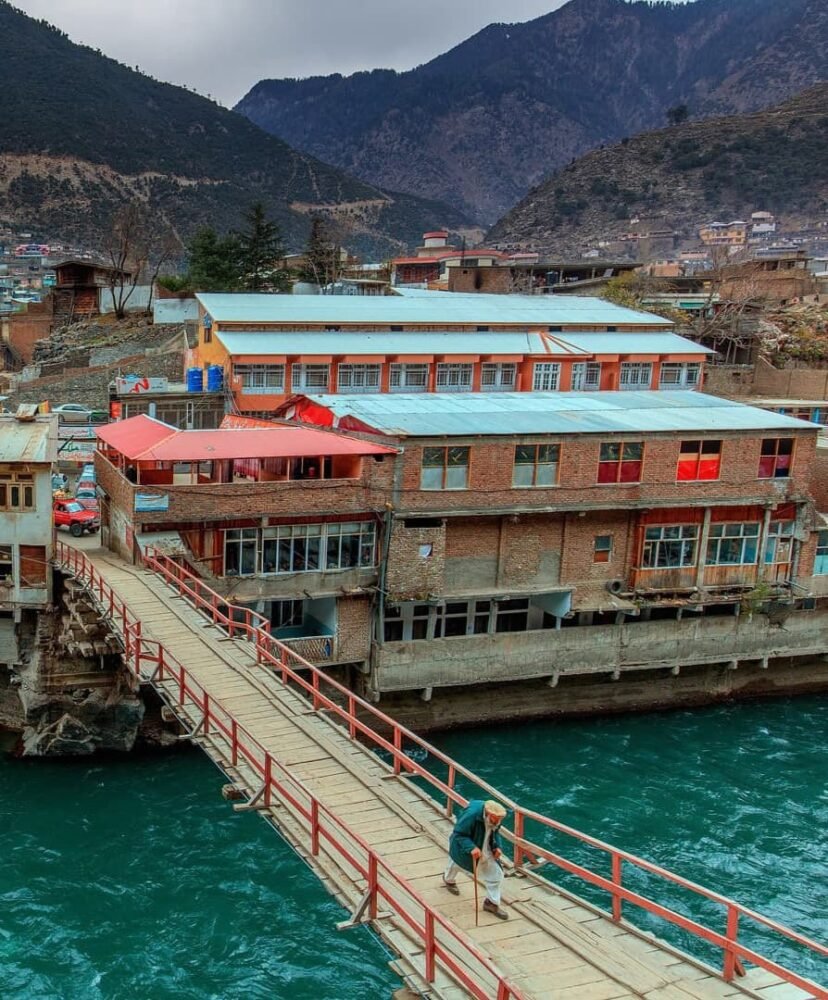
It is in this context that the people of upper Swat now resist the Madyan Hydropower Project. The 207MW project is one of at least 18 schemes planned between Madyan and Kalam. Three of them—Madyan, Asrit-Kedam, and Kalam-Asrit—alone account for 675MW. Additional projects are proposed on Daral, Gurnai, Kedam, Mankiyal, Gabral, and Utror. Among these, the Madyan project has been declared a priority.
Although presented as provincial or private projects, the real power lies with global financiers such as the World Bank and Asian Development Bank.
PEDO and the provincial environmental authorities attempted to push it through with a “public hearing” in a local hotel in July 2023. People attended in large numbers, carrying the trauma of Daral. yet the authorities issued a ‘no-objection certificate.
This prompted the Darya-e-Swat Bachau Tehreek (Save Swat River Movement) to launch sustained resistance in July 2024. Unlike earlier efforts, this movement directly engaged the financier. Since August 2024, we have submitted formal complaints to the World Bank demanding a review under its own environmental and social safeguard policies.
In fifteen months, we have exchanged hundreds of letters with the Bank; held meetings in Peshawar, Islamabad, and online; and engaged PEDO repeatedly under the district administration’s hesitant oversight. We informed international bodies, including UN institutions. Meanwhile, jirgas were held from Madyan to Kalam. A massive demonstration took place on 23 August 2024 in Bahrain; youth marched again a month later. Press conferences in Swat and Islamabad generated national attention. Media campaigns amplified our voices. Even our children wrote to the prime minister.
This resistance has drawn unprecedented global attention. For the first time, international organisations are monitoring a hydropower conflict in northern Pakistan. The World Bank has commissioned a rare study to determine whether the Torwali qualify as Indigenous people under its policy, an unprecedented step in this region.
Yet the central issue remains: communities’ consent.
Hydropower is marketed as “clean energy,” but clean for whom? International law and the UN Declaration on the Rights of Indigenous Peoples (UNDRIP) are clear: no project can proceed without Free, Prior, and Informed Consent (FPIC). What we received instead were rushed hearings, inaccessible documents, procedural shortcuts, and bureaucratic coercion—none of which constitute real consent.
We have made our stance clear: any project that threatens our rights to land, water, culture, and life is unacceptable. Real development strengthens local communities, protects ecosystems, and aligns with climate realities. For us, a river is not a “resource.” It is a relative, a sacred trust, a living memory. To dam it without our consent is to dispossess us of ourselves.
For 15 months, the people of upper Swat have halted this project through peaceful, disciplined, and informed resistance. Whether or not we ultimately prevail, our movement has already achieved something profound: it has reaffirmed that Indigenous rights and environmental justice are inseparable; that rivers have rights because communities have relationships; and that development must be accountable to those who bear its consequences.
Iqbal reminds us that barren lands are never without hope: “A drop of dew is enough to make this soil fertile again.” The resistance of the Torwali people is that drop of dew—an act of dignity, unity, and courage in the face of imposed development.
And as long as the Swat River flows, we will continue to defend it.

Zubair Torwali is an author and language activist hailing from Bahrain Swat. His main interest is the empowerment of the Indigenous communities of northern Pakistan. He has been working on the languages, question of indigeneity and various extractive and developmental projects in North Pakistan.

The High Asia Herald is a member of High Asia Media Group — a window to High Asia and Central Asia