
By: Zhang Chaozhe, Xiang Sihong
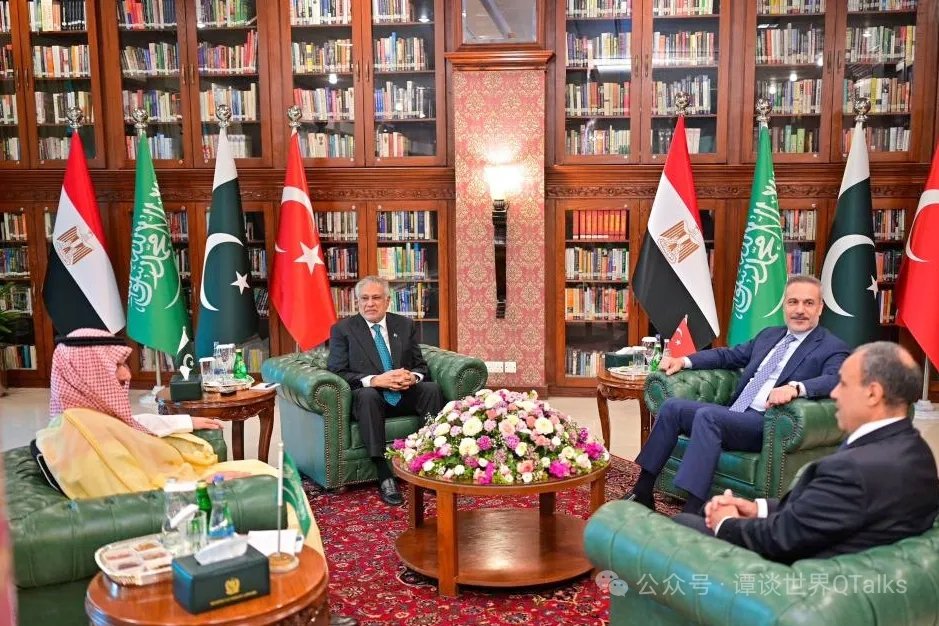
With less than an hour-and-a-half remaining before the “deadline” for military action set by President Donald Trump, the US and Iran separately announced their acceptance of a ceasefire proposal put forward by Pakistan. The two sides are scheduled to begin two weeks of talks on April 10 in Pakistan’s capital city, Islamabad. Iran’s Ambassador to Pakistan, Reza Moghadam, described Pakistan’s mediation as “positive and productive,” noting that the mediation efforts are entering a “critical and sensitive” stage.
What is the regional backdrop to Pakistan’s mediation? What motivates Pakistan to actively mediate? What are the likely trends in post-ceasefire negotiations? Sichuan International Communication Center invited Zhang Chaozhe, Director of the Pakistan Study Center at Sichuan University and Associate Research Fellow at the China-South Asia Research Center, to provide analysis.
Mediation in the regional context
The US-Israeli war against Iran began with Operation Midnight Hammer, launched by the US and Israel against Iran in June 2025. By the end of February 2026, the conflict had escalated once again. The war has now lasted more than 40 days and reached a stalemate. Although Iran has suffered heavy casualties and property damage, Mojtaba Khamenei, son of the late Supreme Leader Ayatollah Ali Khamenei, has smoothly assumed the supreme leadership of Iran, consolidating domestic unity and capacity for resistance. At the same time, Iran has blockaded the Strait of Hormuz, causing global energy prices to soar. The US-Israeli goal of overthrowing Iran’s regime has not been achieved, and their actions have drawn widespread international criticism.
As a neighbour to the Middle East, the sole nuclear-armed state in the Islamic world, and a country heavily dependent on energy imports from the region, Pakistan has a strong desire to see an early end to the war. Against this backdrop, Pakistan’s Chief of Army Staff, General Asim Munir, has become a key liaison between the US and Iran — using his direct personal relationship with Trump (a telephone communication channel established during the India-Pakistan firefights in May 2025) to relay messages between the two sides.
On March 31, Pakistan’s Deputy Prime Minister and Foreign Minister, Mohammad Ishaq Dar, made an urgent visit to China, and together with the Chinese side issued a “five-point Initiative.” Its core elements can be summarized as “cease, talks, and ensure”: an immediate cessation of hostilities, a start of peace talks as soon as possible, security of nonmilitary targets, security of shipping lanes; and primacy of the United Nations Charter. China’s just position and its support for Pakistan played an important role in the US and Iran’s acceptance of Pakistan’s ceasefire proposal.
Multiple motivations for mediation
Pakistan’s proactive mediation is by no means impulsive; rather, it is the inevitable result of multiple strategic considerations.
FIRST, deep historical tradition and unique advantages. Pakistan is arguably the most qualified mediator in the Islamic world. In 1971, Pakistan helped then-US Presidential Envoy Henry Kissinger secretly travel via Beijing, paving the way for Richard Nixon’s visit to China and the establishment of Sino-US diplomatic relations. In 2020, Pakistan facilitated the US-Taliban peace talks and the withdrawal of US troops from Afghanistan. This cross-ideological and cross-geopolitical mediation capability is unique in the Islamic world. More importantly, Pakistan maintains close relations with both the US and Iran: Pakistan has long-standing military cooperation with the US, and General Munir enjoys a good personal friendship with Trump; Pakistan shares nearly 1,000 kilometers of border with Iran, and nearly one-fifth of Pakistan’s 240 million population are Shia Muslims.
SECOND, China’s strategic support and coordination. Pakistan’s mediation is not a solo effort. The “Five-Point Initiative” issued during Dar’s March 31 visit to China is both a vivid manifestation of the China-Pakistan All-Weather Strategic Cooperative Partnership and a source of strong political support for Pakistan’s mediation. China has stressed that the Five-Point Initiative “is open and welcomes the response and participation of all countries and international organizations.” The joint issuance of the Five-Point Initiative provides systemic strength to a smaller country’s mediation efforts, preventing them from being overwhelmed by major-power rivalry. In the US-Israeli-Iranian war, Pakistan seeks Chinese mediation for the Pakistan-Afghanistan border crisis, allowing it to focus on Middle East affairs — highlighting the highly efficient strategic coordination between China and Pakistan. This model of collaboration between a “regional power and a global power” greatly enhances the legitimacy and influence of Pakistan’s mediation.
THIRD, the best option under the Saudi nuclear protection agreement. In September 2025, Pakistan and Saudi Arabia signed a Joint Strategic Defense Agreement, stipulating that “any attack on either party shall be considered an attack on both parties,” with its core principle similar to NATO’s Article 5 collective defense clause. Pakistan’s Defense Minister Khawaja Asif further stated that Pakistan’s nuclear program “can be made available” to Saudi Arabia — in effect providing a nuclear umbrella for Saudi Arabia. In reality, Pakistan’s “nuclear protection” is more a signal to India and Israel. However, after the war broke out, Iran designated Saudi oil facilities as “legitimate targets.” Saudi Arabia’s Foreign Minister issued a strong warning that “patience is not limitless.” Saudi-Iranian relations became tense. This means that if Saudi Arabia were to formally enter the war, Pakistan would be forced to make a painful choice between honoring its nuclear security commitment to Saudi Arabia and avoiding being drawn into a war against Iran. Proactively mediating to promote a ceasefire is the only way out of this dilemma.
FOURTH, urgent domestic energy security and economic survival needs. Pakistan relies on imports for over 80% of its oil needs, with an annual energy import bill of $16-18 billion. As of March 2026, its foreign exchange reserves stood at only about $21.7 billion. After the closure of the Strait of Hormuz, international oil prices surged above $100 per barrel, and Pakistan’s monthly oil import bill jumped to $600 million. Prime Minister Shehbaz Sharif was forced to introduce a series of austerity measures: a 50% cut in fuel subsidies for official vehicles (excluding ambulances and buses); 50% of public sector employees to work from home (excluding those providing essential services); and a 20% reduction in government department spending. Under such grim circumstances, pushing for a US-Iran ceasefire and the reopening of the Strait of Hormuz is not only a diplomatic achievement for Pakistan but also a necessity for its economic survival.
FIFTH, projection of middle-power ambition and domestic authority. Due to his performance in the India-Pakistan conflict and the adoption of the 27th Constitutional Amendment, General Syed Asim Munir has been awarded the rank of Field Marshal and the position of Commander-in-Chief of the Armed Forces, as well as command over nuclear forces. This mediation effort has become his international debut, “stepping from behind the curtain into the spotlight.” Successfully brokering a deal would not only consolidate his domestic authority but also greatly enhance Pakistan’s voice in the Islamic world and globally. As the sole nuclear-armed state in the Islamic world, Pakistan has long aspired to become a true “middle power” — playing an irreplaceable balancing role between the US and China, between Saudi Arabia and Iran, and between East and West. If this mediation leads to a historic peace agreement, it will undoubtedly establish Pakistan as a global mediation power.
Ceasefire is easy, peace is hard
Although a ceasefire agreement has been reached, the prospects for future US-Iran negotiations are not optimistic.
First, Trump’s unpredictability is a major variable. Trump has repeatedly claimed that the US military “destroyed” Iran’s nuclear capabilities, but a classified assessment by the Defence Intelligence Agency reportedly showed that the airstrikes only “delayed Iran’s nuclear program by a few months.” On April 7, just a day before accepting the ceasefire proposal, Trump issued a new threat to Iran, saying, “Tonight, the whole civilisation will die, never to be brought back again.” Given Trump’s style, if negotiations hit a snag, he could easily resort to military pressure again to divert domestic political attention.
Second, Iran’s sense of precaution against “being deceived” is unprecedentedly heightened. In recent years, Iran has been deceived multiple times by the US, with the US launching attacks against Iran while the two sides were negotiating. After Iran’s former Supreme Leader Ayatollah Ali Khamenei was killed in US-Israeli airstrikes, Iran has become highly vigilant toward any US proposal. An Iranian official said earlier that the prevailing view in Iran is that “the US request for negotiations is another deception, aimed at launching another attack when we are off guard.” Iran has now proposed a 10-point plan, with core demands including the lifting of all US sanctions, the release of frozen assets, and the withdrawal of US combat forces, while stressing that “negotiations are a continuation of the battlefield” — indicating that Iran is prepared to continue fighting if talks fail.
Third, Israel’s disruptive intentions cannot be ignored. Even after the ceasefire took effect, Israel continued its strikes on Iran. Israel has expressed concern over the US acceptance of Pakistan’s proposed temporary ceasefire, claiming it still has more targets on its list and seeking to achieve its objectives through military action in Iran.
For Israel, the ultimate goal is to completely destroy Iran’s nuclear capabilities. Any diplomatic arrangement that would allow Iran to make a “dignified exit” runs counter to its strategic interests. During the two weeks of negotiations, Israel is highly likely to disrupt the peace process by intensifying military pressure.
In summary, Pakistan has demonstrated impressive diplomatic skill and strategic resolve in its mediation efforts. However, whether it can truly pull the US and Iran out of the quagmire of war remains to be seen. The two-week ceasefire window is both a valuable opportunity and potentially just the calm before the storm.

Zhang Chaozhe is Director of the Pakistan Study Center at Sichuan University and Associate Research Fellow at the China-South Asia Research Center. His research focuses on major-power relations and South Asian affairs.
Xiang Sihong is an Assistant at the Pakistan Study Center, Sichuan University

The High Asia Herald is a member of High Asia Media Group — a window to High Asia and Central Asia