

by Rizwan Karim
(This account is based on lived experience and oral narratives I’ve heard. It does not claim research-based or archival authority but reflects vernacular memory and community knowledge.)
Shab-i-Yalda (Yalda Night), the celebration of the longest night of the year, is widely observed tonight across Iran, Afghanistan and the Persianised world. In the Gilgit-Baltistan region of Pakistan, a locally rooted version of the winter solstice festival is known as Thumushaling (also pronounced Thumshuling) in and around Gilgit and Mayfung in Baltistan is observed on the night of 20–21 December.
In Gilgit-Baltistan, Thumushaling/ Manfung is both seasonal and cosmological in significance. The longest night is believed to mark a turning point: the sun, having reached its furthest retreat, begins its return, symbolising renewal and the promise of a new year. Traditionally, young people gather to eat, drink, sing, dance, and remain awake through the night in communal celebration. Fire occupies a central place in these festivities. A large bonfire is lit, around which participants circulate, often spinning handheld fireballs while dancing—ritual gestures that echo older cosmologies in which fire represents purification, renewal, and protection against darkness.
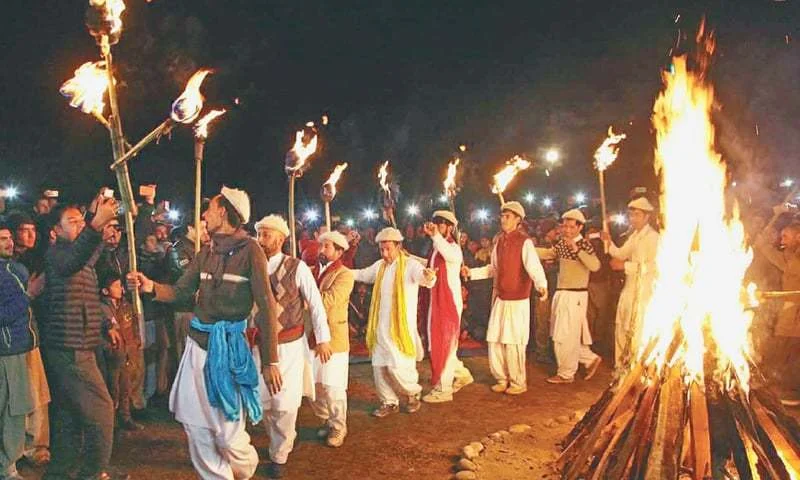
The prominence of fire is frequently interpreted as a legacy of Persian and Zoroastrian cultural influence, which historically permeated large parts of the region. Fire, in this worldview, is not merely a source of warmth but a sacred element embedded in the socio-religious imagination of the people.
Beyond its cosmological symbolism, Thumushaling/ Taleno in Gilgit is also entangled with a powerful historical legend: the story of Shiri Badat, remembered in local lore as the last Buddhist ruler of Gilgit. According to oral traditions later recorded in colonial-era writings, Shiri Badat allegedly developed a taste for human flesh,specifically that of infants after consuming it accidentally. This act is said to have transformed him into a cannibalistic tyrant who preyed upon children.
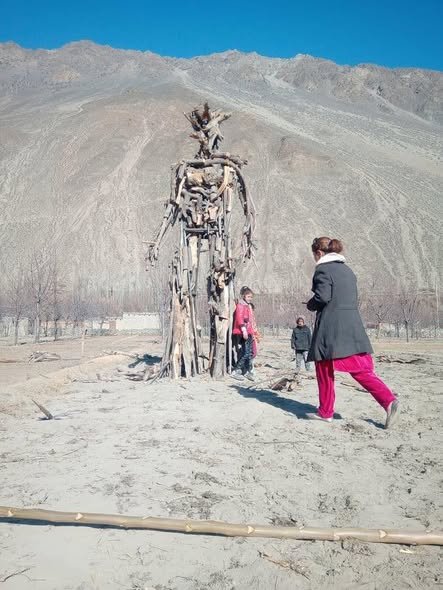
The narrative continues with the figure of Azur Jamshed, who, having married Shiri Badat’s daughter, Nur Bakht, conspired to kill the king. Shiri Badat was believed to possess supernatural powers that rendered him nearly immortal; only his heart, said to be made of butter could be destroyed by heat only. Armed with this knowledge, conspirators allegedly set his palace on fire. Some versions of the legend claim that Shiri Badat fled towards Ghizer, where he disappeared beneath a glacier.
Modern interpretations of this legend vary. Some scholars and commentators suggest that Shiri Badat’s alleged cannibalism may be symbolic, possibly alluding to sexual exploitation of minors. In contemporary vernacular, the term “Shiri Badat” is sometimes used to describe sexual predators, particularly those targeting children. However, the historical veracity of these claims remains difficult to establish, given the absence of contemporaneous written sources and the reliance on oral transmission.
Also Read: Rise and fall in the age of social media
It is also significant that the fall of Shiri Badat is traditionally linked to the rise of the Trakhan rulers in Gilgit, dated roughly to the mid-eighth century. This has led some to argue that accusations of cannibalism may have functioned as a political narrative, constructed or amplified to delegitimise Buddhist rule and justify a transition of power. Such demonisation of former rulers is not uncommon in oral historiography.
Whatever its historical origins, Thumushaling in Hunza also known as Taleno in parts of Gilgit-Baltistan has come to be celebrated as a festival of fire symbolising the triumph of good over evil. The burning of effigies associated with Shiri Badat is widely understood as a ritualised remembrance of the community’s moral victory over tyranny and darkness.
The festival also overlaps with Rasm-e Nasalo, a winter ritual observed in certain parts of the region. On or around 20 December, an animal that has been fattened throughout the year is slaughtered to provide sustenance for the harsh winter months. Young people dress in disguises known as Jat Hir (literally “old men”) and go door to door collecting flour or other provisions. These contributions are later used to prepare communal meals consumed during the night-long celebrations.
Together, these practices reveal Thumushaling/Taleno or Mayfung as more than a seasonal festivity. It is a layered cultural event, interweaving cosmology, oral history, ritual economy, and moral memory through which communities in Gilgit-Baltistan mark time, negotiate the past, and reaffirm social bonds in the depths of winter.

Rizwan K Qalandar hails from Hunza Gilgit-Baltistan currently living in London, UK. He is a researcher, digital storyteller, working at the IIS Special Collections on the Global Oral History Project. He has a passion for writing on social, political and cultural issues of Gilgit-Baltistan.

The High Asia Herald is a member of High Asia Media Group — a window to High Asia and Central Asia