
Diamer Division comprises Astore and Diamer districts, the most neglected and impoverished region in Gilgit-Baltistan. Poverty rates exceed 60–70% in the rural sub-districts of Darel and Tangir, while Astore is marginally better off. Literacy remains critically low: approximately 40–50% for males but only 20–30% for females — among the lowest in Gilgit-Baltistan due to restricted access and deep-rooted cultural constraints. Maternal and infant mortality rates are high, as tertiary healthcare is scarce.
The valleys of Tangir and Darel are particularly isolated, with frequent road closures exacerbated by the vulnerability of the Karakoram Highway. Access to business and employment is limited by poor internet and power infrastructure, as well as a near-absence of formal jobs. Governance is weak due to minimal administrative presence; consequently, people rely heavily on local elites and kinship networks.
In such backward settings, elections are not fought over policy manifestos but on biradari (clan) loyalty, personal reputation, charity networks, and access to state resources. Voters are highly sensitive to even small material incentives. Dynastic politics is strong as personal trust is inherited, making parties secondary to family names.
Three constituencies—Diamer-I, Darel, and potentially Astore-I—are likely to be decided by under 100 votes, making elections expensive and prone to post-poll disputes. PTI-backed independents (due to PTI’s loss of its electoral symbol) fragment the anti-PML-N vote, possibly benefiting PML-N and JUI.
Despite a female voter majority in Diamer-I, no major female candidate exists in the division except Shahida Khurshid. Weak state services and strong religious/clan networks shape voter choice; JUI’s strong showing in Darel reflects madrassa-based social welfare, where religious parties provide schools, clinics, and dispute resolution in the government’s absence.
The 2026 Diamer Division election is less a democratic exercise in policy choice and more a reflection of structural underdevelopment. The razor-thin margins, dynastic candidates, and weak party loyalties are not signs of democratic vitality but symptoms of a society where the state has failed to replace kinship with citizenship. Each constituency tells the same story: isolation, poverty, and the enduring power of the familiar face.
Constituency-by-Constituency Analysis
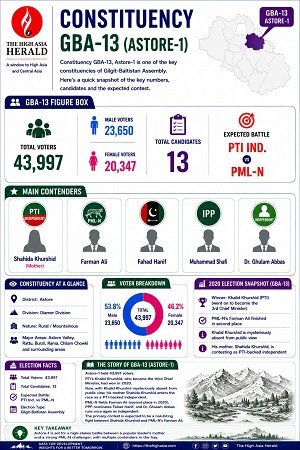
GBA-13, Astore-I:
The total number of voters 43,997 (Male: 23,650, Women: 20,343)
In the absence of former Chief Minister Khalid Khurshid, his mother Shahida Khurshid runs as a PTI-backed independent—a rare female candidate in a conservative area. Her entry signals dynastic politics and an attempt to capture sympathy votes. However, female voter mobilization in Astore remains low; her success depends on male biradari support. Her main rival is PML-N’s Farman Ali (the runner up in 2020), who has strong pockets due to development promises.
Farman Ali has a slight edge due to PML-N’s incumbency, but Shahida could win on sympathy. PPP has nominated Fahad Hanif. IPP’s Muhammad Shafi and independent Dr Ghulam Abbas are also in the run.
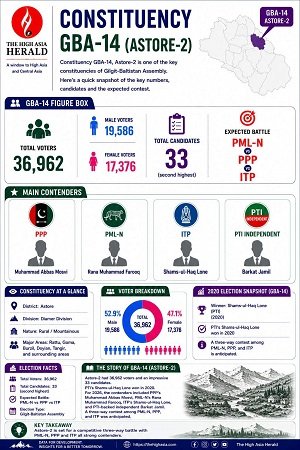
GBA-14, Astore-II:
In GBA-14, Astore-II, 36,962 voters (male 19,586, female 17, 376) will elect their representative from 33 candidates. This constituency has perhaps the highest number of candidates in Gilgit-Baltistan, which could split votes and produce a very low winning margin (as in 2020’s 18-vote margin in Darel). Voters trade ballots for small favours.
PPP has nominated Muhammad Abbas Mosvi, an educated and well-reputed newcomer. PML-N fields Rana Farooq, while Istehkam-e-Pakistan Party (IPP) has given a ticket to Shams Lone (who had won in 2020, and a PTI-backed independent, Barkat Jamil, also runs. IPP may fragment the anti-PML-N vote. A three-way contest among PML-N, PPP, and IPP is expected.
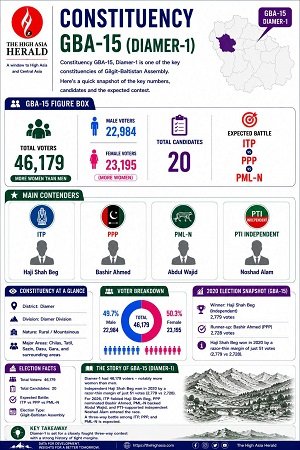
GBA-15, Diamer-I:
The total number of voters is 46,179 (Male 22,984, Female: 23,195). Twent candidates are in the fray. This constituency has a demographic anomaly: women outnumber men, which is rare in Gilgit-Baltistan voter rolls. This suggests either effective female voter registration or male labour migration. In 2020, independent Haji Shah Beg won by just 51 votes.
For 2026, the prominent contenders are IPP’s Haji Shah Beg, PPPP’s Bashir Ahmed, PML-N’s Abdul Wajid, and PTI-backed Noshad Alam. A three-way contest among IPP, PPP, and PML-N is seen. Shah Beg’s incumbency gives him an edge, but his 2020 margin was razor-thin.
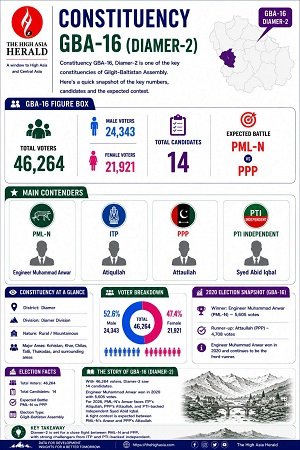
GBA-16, Diamer-II:
The GBA-16, Diamer-II has 46,264 voters, (Male: 24,343, female: 21,921). Fourteen candidates are in the fray. In 2020, PML-N’s Engineer Muhammad Anwar won with 5,605 votes. This time, he faces IPP’s Atiqullah, PPP’s Attaullah, and PTI-backed Syed Abid Iqbal. A tight contest between PML-N’s Anwar and PPP’s Attaullah is expected. The PTI-backed independent may split the anti-PML-N vote, benefiting Anwar.
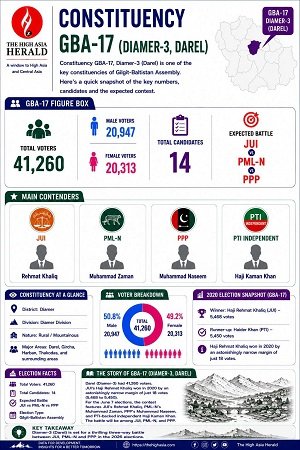
GBA-17, Diamer-III, Darel:
Total 41,260 voters (Male: 20,941, female: 20313). In 2020, JUI’s Haji Rehmat Khaliq beat PTI’s Haider Khan by only 18 votes (5,468 vs 5,450)—epitomizing Diamer’s hyper-competitive, high-stakes local politics. For 2026, JUI’s Rehmat Khaliq faces PML-N’s Muhammad Zaman, PPP’s Muhammad Naseem, and PTI-backed Haji Kaman Khan.
JUI has a strong madrassa network in remote areas, providing social services where the state fails. PML-N offers a development narrative. JUI expected to win by a thin margin.
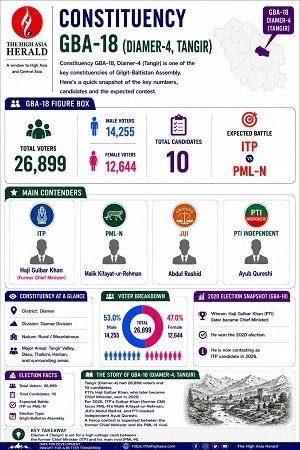
GBA-18 (Diamer-IV, Tangir):
Total 26,899 voters (Male: 14,255, Female: 12,644) – lowest in Diamer Division)
The toughest contest here is between former Chief Minister Gulbar Khan (who had won on PTI ticket in 2020) and PML-N’s Malik Kifayatur Rehman. Gulbar Khan now runs as IPP’s candidate.
For Diamer Division to move beyond clan-and-cash elections, there is a need for a massive investment in female education to empower women; improve road infrastructure in Darel and Tangir to integrate isolated populations and ensure effective local governance to reduce reliance on clan elites and the timber mafia. Without these, elections in Diamer will remain a contest of clans and cash.–Infographics by D.W.Baig

The High Asia Herald is a member of High Asia Media Group — a window to High Asia and Central Asia