

Comprising the four districts of Gilgit, Ghizer, Hunza, and Nagar, the Gilgit Division is far more than an administrative entity. It is the region’s volatile nerve centre and seat of power where sectarian loyalties, ethnic identities, and political grievances converge. Every decision taken here sends shockwaves through the entire Gilgit-Baltistan.
Against this backdrop of fragile equilibrium, the current electoral battlefield reveals a fractured landscape: the Pakistan Peoples Party Parliamentarians (PPPP) has deployed 23 candidates, the Pakistan Muslim League-Nawaz (PML-N) 22, and the PTI-backed independents 19. Yet the real chess moves happen in the shadows—most notably a calculated seat adjustment between the Majlis-e-Wahdatul-Muslimeen (MWM) and PTI/independents on four key seats.
Other players jostle for space: Istehkam-e-Pakistan Party (IPP) with 15, Islami Tehreek Pakistan (ITP) with 10, Pakistan Nazariati Party (PNP) with 10, Jamiate Ulema Islam Fazlur Rehamn (JUI-F) with 9, MWM with 7, both Jamaat-e-Islami and MQM with six candidates each, and the Left-leaning Awami Workers Party Gilgit-Baltistan (AWPGB) with Four. Balawaristan National Front (BNF) supreme leader and two-time MP is contesting as independent.
GBA-1: Gilgit-I
In the heart of the region’s capital, GBA-1 (Gilgit-I) holds 49,015 voters (26,359 men, 22,656 women). Twenty-three candidates are in the fray, but the real war is a four-cornered affair. In 2020, PPPP’s provincial president Amjad Hussain triumphed with 11,752 votes. Independent candidate Sultan Raees followed with 8,356, while PTI’s Johar Ali limped behind at 1,713 votes.
Now the battlefield has been redrawn: Mr Amjad returns to defend his seat. Moulana Sultan, now under the IPP banner, seeks vengeance. PML-N has fielded Muhammad Shafiuddin.
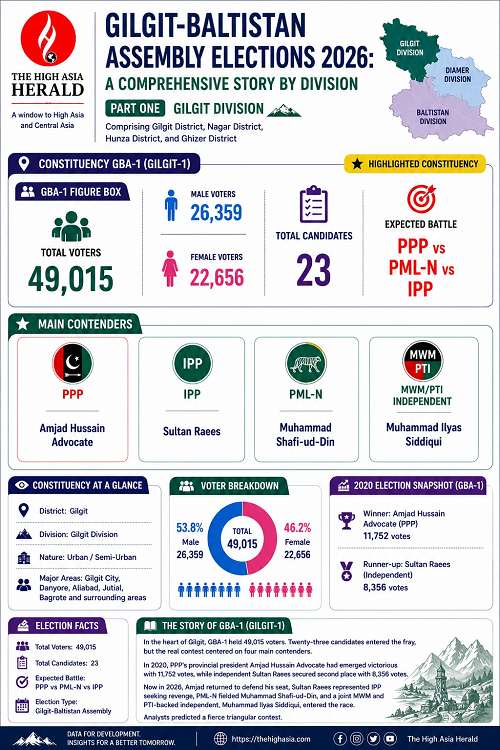
And in a move dripping with sectarian-political significance, a joint MWM-PTI-backed independent, Muhammad Ilyas Siddiqui, enters the fray. Analysts predict a fierce triangular clash between PPPP, PML-N, and IPP. But the MWM-PTI alliance could give tough time for the main contenders.
GBA-2: Gilgit-II
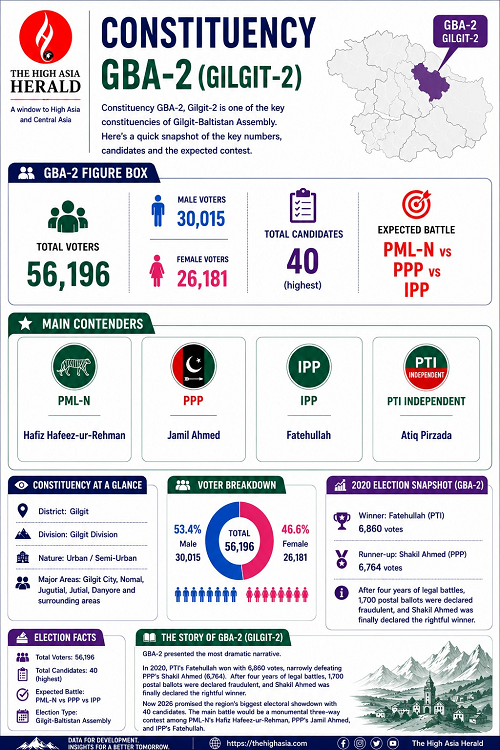
This constituency is the most dramatic, and bitter, of the entire election. With 56,196 voters (30,015 men, 26,181 women), GBA-2 hosts over two dozen candidates, perhaps the highest in the region. T he 2020 election was a rollercoaster. PTI’s Fatehullah won by a razor-thin margin of 6,860 votes against PPPP’s Shakil Ahmed who bagged 6,764 votes. But the story did not end there. Jamil challenged Fatehullah’s victory before an election tribunal. After four years of legal battle, 1,700 postal ballots were declared fraudulent. Shakil was finally declared winner. PML-N had suffered a humiliating blow in 2020, with their provincial president and former chief minister Hafeezur Rehman managing only 5,820 votes.
This time, the biggest electoral showdown looms. PML-N’s regional president Hafeezur Rehman, PPPP’s Jamil Ahmed, IPP-backed Fatehullah, and PTI-supported independent Atiq Pirzada are facing a three-way battle.
GBA-3: Gilgit-III
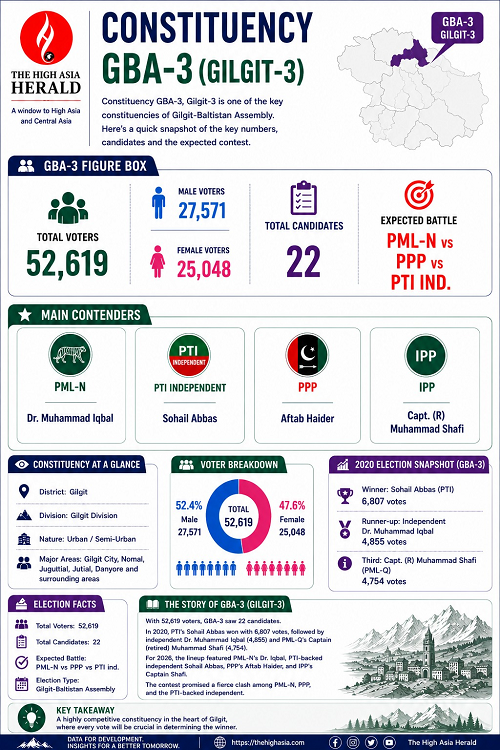
With 52,619 voters (27,571 men, 25,048 women), GBA-3 features 22 candidates. In 2020, PTI’s Sohail Abbas won with 6,807 votes. Independent Muhammad Iqbal followed (4,855), PML-Q’s Muhammad Shafi (4,754), PPP’s Aftab Haider (3,799), and PML-N’s Zulfiqar Ali (2,726).
For 2026, PML-N’s Muhammad Iqbal, PTI-backed independent Sohail Abbas, PPP’s Aftab Haider, and IPP’s Muhammad Shafi are contesting. A fierce clash among PML-N, PPP, and the PTI-backed independent is expected but here, yesterday’s loyalties are tomorrow’s betrayals.
GBA-4: Nagar-I
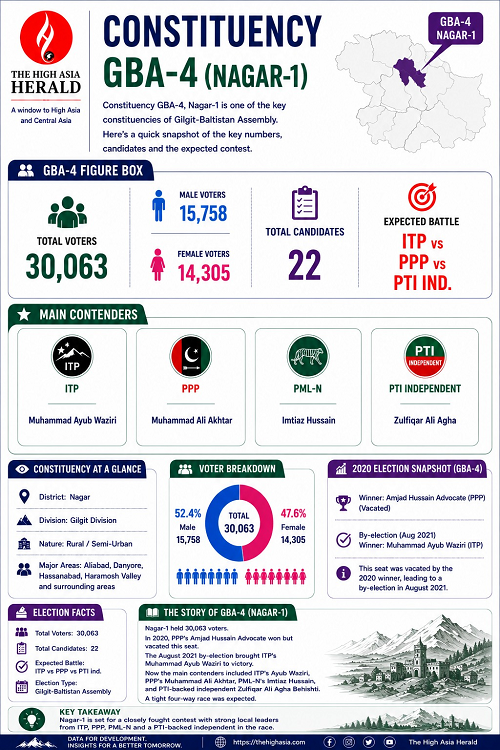
Nagar-I holds 30,063 voters (15,758 men, 14,305 women) and 22 candidates. In 2020, PPPP’s Amjad Hussain won with 6,104 votes but he held two seats and vacated this one. The August 2021 by-election brought ITP’s Muhammad Ayub Waziri to power with 5,422 votes, narrowly defeating PTI’s Agha Behishti (4,808) and PPP’s Javed Hussain (4,348).
Now the main contenders are ITP’s Ayub Waziri, PPP’s senior leader Muhammad Ali Akhtar, PML-N’s Imtiaz Hussain, and PTI-backed independent Agha Behishti. A tight, four-way dogfight is expected.
GBA-5: Nagar-II
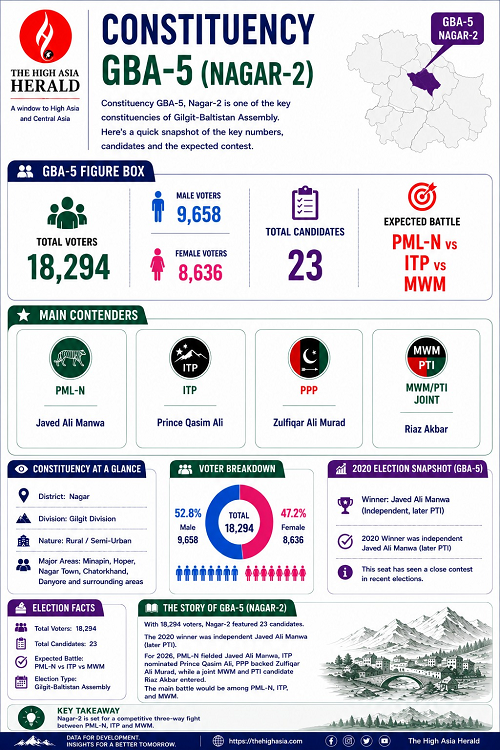
Nagar-II, with 18,294 voters (9,658 men, 8,636 women), features 23 candidates. The 2020 winner was independent Javed Ali Manwa with 2,562 votes who later joined PTI. Zulfiqar Ali Murad (independent) secured 2,149, MWM’s Haji Rizwan Ali got 1,799, PPPP’s Mirza Hussain 1,257, and PML-N’s Sajid Hussain 558.
This time PML-N has fielded Javed Ali Manwa, ITP has nominated Prince Qasim Ali, a member of the former Mir family. PPPP backs Zulfiqar Ali Murad, while a joint MWM-PTI candidate, Riaz Akbar is a new entrant. The main battle will be among PML-N, ITP, and MWM—a perfect triangle of ambition, ideology, and bloc politics.
GBA-6: Hunza
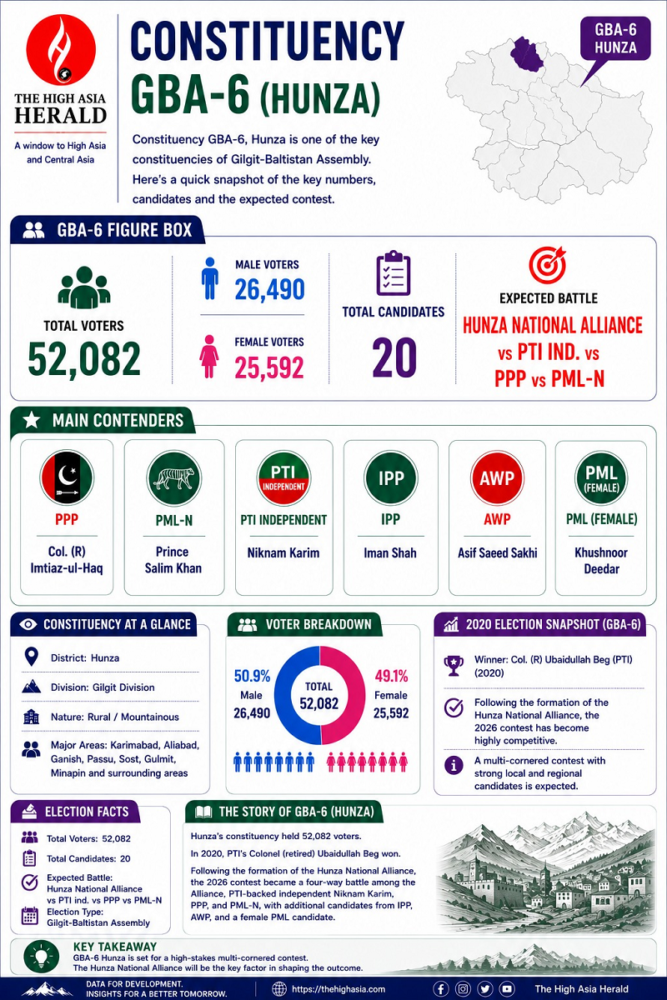
Hunza’s constituency holds 52,082 voters (26,490 men, 25,592 women) and 20 candidates. In 2020, PTI’s Col (retd) Abedullah Beg won with 5,710 votes. He recently joind PPPP. Independent Noor Muhammad secured 4,683, PPP’s Zahoor Karim 4,193, independent Kamil Jan 3,797, and AWPGB’s Asif Saeed Sakhi 2,629.
The 2026 lineup in Hunza is as fascinating as it is fraught with deeper meaning. This is not just another constituency; it is the region’s economic gateway. With one of the highest literacy rates in not only in the G-B but also Pakistan and a strategic position on the border trade route, Hunza has long prided itself on its pluralism and relative moderation. Yet beneath that progressive veneer, a quiet storm is brewing.
PPP has fielded Imtiazul Haq, a retired colonel, representing establishment continuity; PML-N’s Prince Salim Khan, a symbol of traditional feudal aristocracy; PTI-backed independent Neknam Kari, IPP’s Iman Shah; AWP’s Asif Sakhi, the youngest and perhaps most popular candidate among Gen-Z, embodying a progressive idealism and the restless energy of digitally native, educated youth. But the real spoiler is the formation of the Hunza National Alliance, a bloc of disgruntled activists from mainstream Pakistani parties who reject both traditional loyalties.
The contest is now expected to be a four-way war: the PPPP, the PML-N, the PTI-backed independent, and the AWP. Yet beyond the arithmetic of parties lies a deeper, more unsettling reality. In Hunza, the election is no longer just about winning a seat. It is a battlefield for the soul of the valley. On one side stand the traditional status quo forces, the ruling elite, members of the religious establishment who have managed voters’ consent for decades, a newly emerging moneyed class that buys influence rather than earning legitimacy.
On the other side rises a new phenomenon—educated, connected, and increasingly radicalised youth who see the old guard as inept, complacent, and complicit with Pakistan’s ruling elite and the power that be.
Frustrated by unemployment, power and internet crises, blocked from real political power, and exposed to the tidal forces of globalization, these young voters are no longer seeking reforms. They are demanding structural change by dismantling the old order.
GBA-19: Ghizer-I
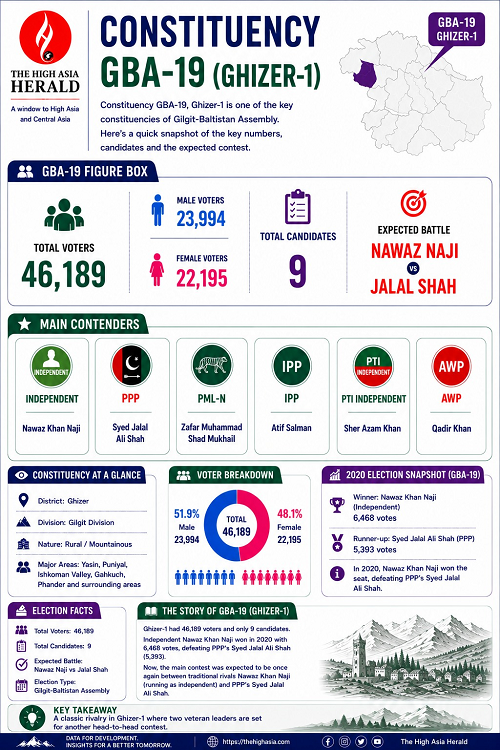
Ghizer-1 has 46,189 voters (23,994 men, 22,195 women) and just 9 candidates. In 2020, BNF leader Nawaz Khan Naji — twice member of the GBA — contested as independent and won with 6,468 votes. PPP’s Syed Jalal Ali Shah secured 5,393, independent Shakeel Ahmed 3,363, and PTI’s Zafar Muhammad Shadamkhel 2,090.
The 2026 field includes Naji, PPPP’s Jalal Ali Shah, PML-N’s Zafar Shadamkhel, IPP’s Atif Salman, PTI-backed independent Sher Azam Khan, and AWP’s Qadir Khan. The main contest remains the old, bitter rivalry between Naji and Shah.
GBA-20: Ghizer-II
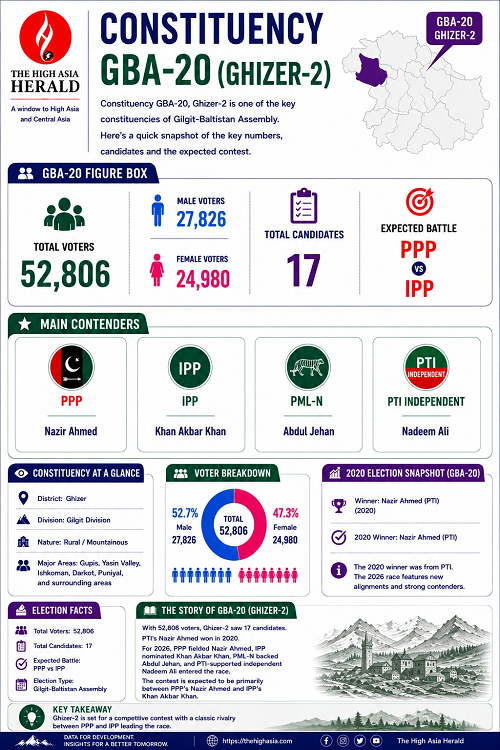
Ghizer-II has 52,806 voters (27,826 men, 24,980 women) – the highest number of votes in the region- and 17 candidates.
In 2020, PTI’s Nazir Ahmed won with 5,456 votes. PML-Q’s Khan Akbar Khan secured 4,235, PPP’s Ali Madad Sher 3,234, independent Attaur Rehman 2,435, and PML-N’s Nazar Khan 1,929. For 2026, PPP has fielded former speaker Nazir Ahmed, IPP has nominated Khan Akbar Khan, PML-N has nominated Abdul Jehan, and PTI-supported independent Nadeem Ali. The contest is expected to be a two-way match between Nazir and Khan Akbar but defectors never sleep easy.
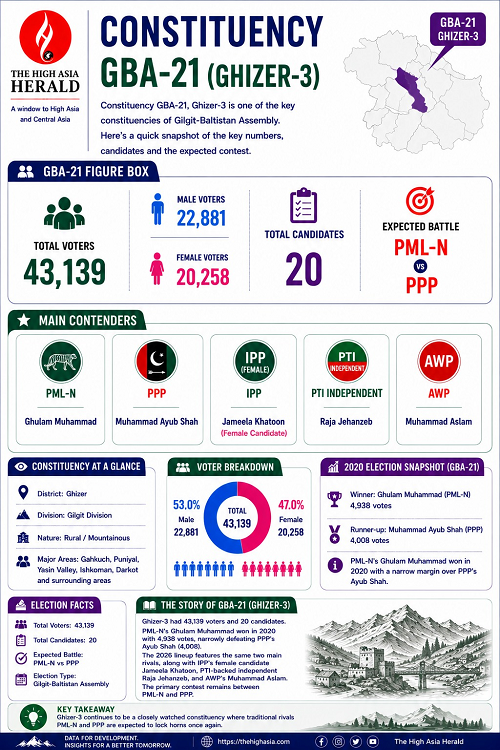
GBA-21: Ghizer-III
G hizer-III has 43,139 voters (22,881 men, 20,258 women) and 20 candidates. In 2020, PML-N’s Ghulam Muhammad won with a thin margin of 4,938 votes. PPPP’s Ayub Shah secured 4,008, independent Hafeezur Rehman 3,313, and PTI’s Raja Jehanzeb 2,454.
This time lineup features PML-N’s Ghulam Muhammad, PPPP’s Muhammad Ayub Shah, IPP’s Jameela Khatoon, PTI-backed independent Raja Jehanzeb, and AWP’s Aslam Inqilabi. The contest is expected to be a direct duel between PML-N and PPP, the two old guards who refuse to yield, even as the ground shifts beneath them.–Infographics and additional input by D.W.Baig

The High Asia Herald is a member of High Asia Media Group — a window to High Asia and Central Asia