
by Dr Zahid Usman
Avestan alongside Old Persian, is one of the oldest attested and transmitted Iranian languages. Preserved in the sacred text of the Parsis, collectively known as the ‘Avesta’, it belongs to the Indo-Iranian branch of the Indo-European language family, distinguished from other branches by both geographic and chronological factors. The term “Iranian” in this context does not refer to a strictly geographic designation but rather to a linguistic grouping. Iranian languages are spoken across the West Asia (Middle East) and Central Asia and include Persian, Dari, Kurdish, Balochi, Pashto, Ossetic, Tati, and Wakhi. Ancient Iranian languages such as Scythian and Median are known only through indirect or fragmentary evidence.
High Asia and Trans-Himalayas are home to a distinct group of ancient tongues collectively called as Pamiri languages. They are not mutually intelligible and grouped in the Modern Eastern Iranian language family and are spoken in High Asia for more than a millennium. They form a linguistic bridge between the Eastern Iranian languages like Pashto and Ossetic, and the extinct Saka languages of the Tarim Basin (Khotanese and Tumshuqese).
Linguists believe the Pamiri languages were once spoken over a much wider, lower-lying area of the Bactrian-Margiana region (northern Afghanistan, Turkmenistan, Uzbekistan, and Tajikistan). The spread of more powerful Iranian languages (first Bactrian and Khwarezmian, then later Persian/Tajik, and finally Turkic languages like Uzbek and Kyrgyz) pushed Pamiri speakers into the high-altitude Pamirs and Hindukush.
The mountains acted as a “linguistic museum” preserving ancient features lost elsewhere. They retain three grammatical genders (masculine, feminine, neuter) – an archaic feature lost in most other Iranian languages. They have complex evidentiality systems (marking whether you witnessed an action or heard about it). Their vocabulary includes a pre-Iranian substrate (possibly from an unknown language family spoken in the Pamirs before the Iranian migrations).
Almost all Pamiri speakers are Nizari Ismaili Muslims. This sets them apart from Sunni Tajiks, Uzbeks, Pashtuns, and most Chinese Uyghurs; from Shia (in Iran, Azerbaijan, and parts of Iraq and Pakistan), from other Ismaili communities (in South Asia, Syria, or East Africa).
The religious difference has historically reinforced linguistic and ethnic boundaries. In Tajikistan, for example, the Pamiri valleys have hundreds of Pamiri maddoh (religious chanting traditions) in Shughni and Wakhi, not in Persian or Arabic.
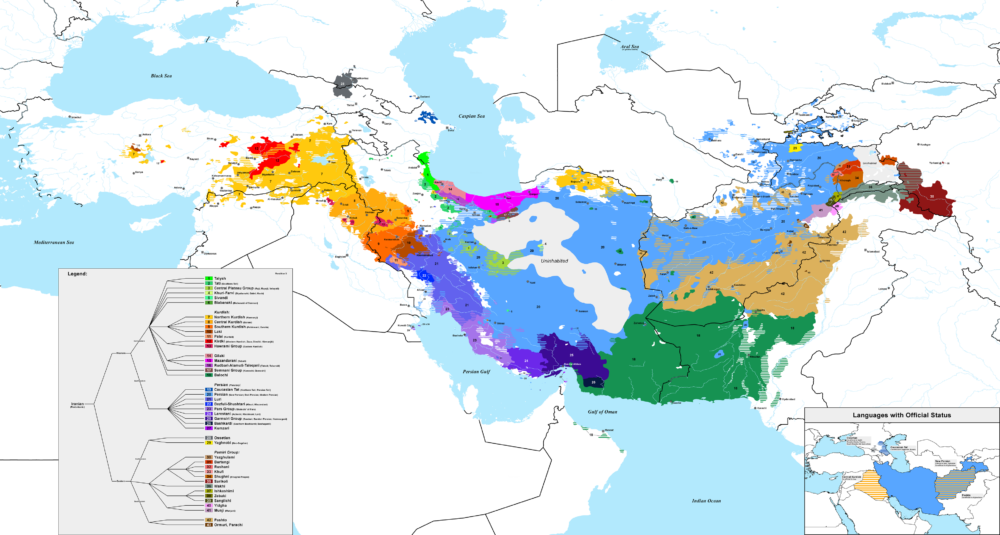
Fig-1: The Distribution of Iranian (Iranic) Languages (Source:
A family of many languages
It is believed that none of the Pamiri languages are indigenous to their present location despite of their long history as they signify centuries of social and cultural interaction, and migration in one of the most linguistically perplexed mountain regions in the world. They are scattered in mountain valleys of Karakoram, Pamir, and Hindukush across Pakistan, Afghanistan, Tajikistan, and China. A large number of Pamiri speakers live in the Badakhshan Mountainous Autonomous Region (GBAO) of Tajikistan followed by Gilgit-Baltistan and Chitral of Pakistan. In contrast, smaller communities live in Afghan Badakhshan and Tashkurgan of China’s Tajik Autonomous County.
Pamiri languages are a cluster of vernaculars languages including Shughni-Rushani group (Shughni, Rushani, Khufi, Bartangi, Oroshorvi, and Sariqoli), Yazgulyam, Wakhi, Ishkashimi, Sanglechi, Munji and Yidgha. There are various dialects of almost every language, for instance, Bajuwi, Barwazi, and Shahdara of Shughni, and Khufi dialect of Rushani, etc. Sokolova (1973) asserts that Munji and Yidgha are also considered in the same group due to their close relation and historic proximity to Bactria.
According to linguists like Morgenstierne (1938) and Oranskij (1979), these languages do not descend from a single ancient East Iranian source because of their similarities and striking differences. Dodykhudeov (1970) and Edelman (1980, 1981) suggest that shared geography, predominant belief system (Ismaili Islam), and centuries of bilingualism with Persian varieties like Dari and Tajiki evolved them into a structurally recognisable linguistic family.
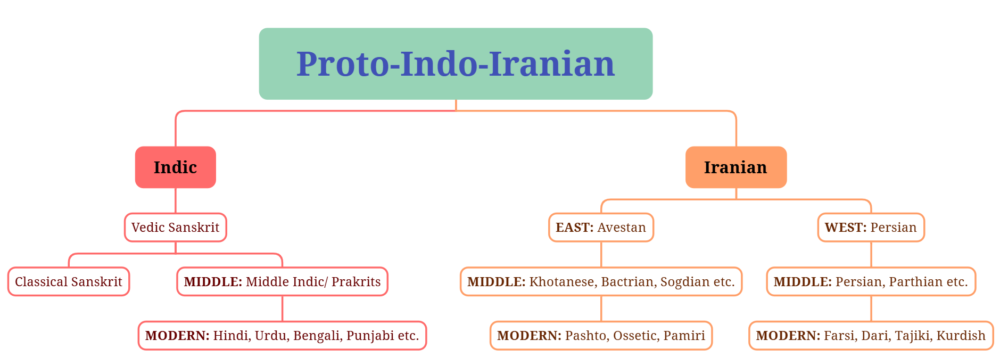
Fig-2: Proto-Indo-Iranian Language Family (Source: Grundriss)
From “Ghalcha” to “Pamiri”
Historically, these languages were termed as ‘Ghalcha’ as the 19th century British scholarship like R.B. Shaw (1876, 1877) labelled them using a Turkic exonym applied vaguely to mountainous people of Iranian origin. In his Linguistic Survey of India in 1921, G. Grierson also adopted the same terminology of Ghalcha while referring to these languages. However, due to rejection by locals and scholars like Bartold (1963) this label was questioned for its negative connotation. Consequently, the early 20th century scholarship such as I. I. Zarubin (1924) and Wilhelm Tomaschek (1880) proposed the current standard term ‘Pamiri languages’. Edelman (1964), Pahalina (1969), and Karamsoev (1977) believed that this designation became dominant in Russian and international scholarship as it emphasizes geography rather than ethnicity.
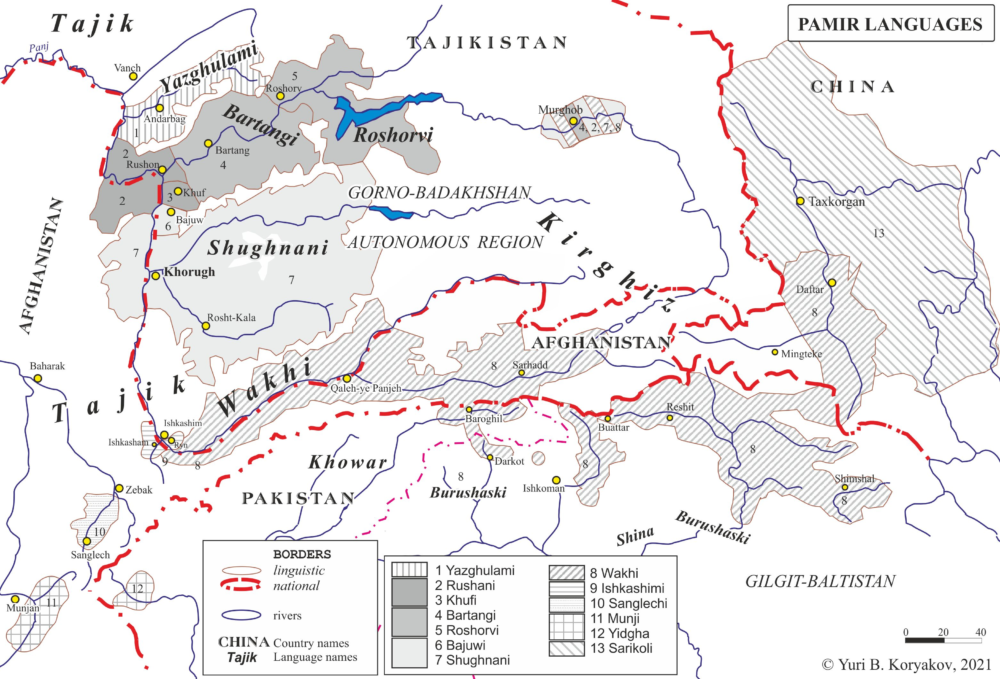
Fig-3: Geographical Distribution of Pamiri Languages (Source: Koryakov)
From margins to erasure: language and nation-building
The Pamiri languages are under pressure from global forces, shaped by colonial era policies, administrative control and internal hegemony of dominant regional languages. Despite their linguistic, cultural, and religious distinctiveness, Pamiri languages were denied independent status, excluding them from formal education and administration.
For instance after the socialist revolution in Russia, new administrative units like GBAO were created. But the state language is Tajik, a Western Iranian language closely related to Persian. Soviet-era policies and post-independence nationalism have marginalised Pamiri languages in education and media.
In Afghanistan, decades of war, along with the dominance of Dari Persian and Pashto, have eroded Pamiri languages in Badakhshan. Similar precedents are observed in the Gilgit-Baltistan, and Chitral. In Pakistan, Urdu dominates education and government. In China’s Tashkurgan, Sarikoli, a Pamiri language closely related to Shughni, is spoken by the officially recognised Tajik minority, but Mandarin is advancing rapidly. Consequently, Tajik, Shina, Burushaski, Urdu, Uyghur, and Mandarin gradually became the dominant languages of public life.
As Hudoërov argues, Pamiri languages lack meaningful state recognition and remain absent from most institutional domains, similar to what Cacopardo and Kreutzmann note for Wakhi in Pakistan, and Dwyer and Opgenort for Sarikoli in China. State-sponsored languages dominate literacy, schooling, and public administration, perpetuating marginalisation and restricting intergenerational transmission. Thus, the Pamiri linguistic ecology faces a regional pattern of homogenisation, leading to widespread bilingualism and, in many cases, language shift.
Beyond bilingualism, economic pressures, digital media, migration, changing livelihoods, and urbanisation have further weakened intergenerational transfer, especially among younger speakers. Yazghulami, Roshorvi, and Ishkashimi are now considered severely threatened, along with nearly all other Pamiri languages.
Language serves as a broader identity marker, capable of fueling political and cultural mobilisation and acting as a central axis of collective identity. Yet as spoken use declines, Pamiri languages have taken on heightened symbolic value. Even speakers of distinct languages like Wakhi or Shughni increasingly identify as Pamiris, referring to their mother tongues collectively as “Pamiri.” This slippage between linguistic specificity and socio-cultural self-designation is mirrored in television and social media representations.
Many Pamiris interpret the systematic exclusion of their languages as a form of gradual assimilation. Scholars fear that inconsistent labels such as Badakhshani, Tajiki, Gilgiti, and Hunzai obscure linguistic diversity and accelerate the erosion of smaller languages.
Despite growing recognition and emerging revitalisation efforts framing Pamiri languages as endangered cultural heritage of High Asia, their long-term future remains precarious. These languages are living repositories of identity, memory, and worldview.
Linguists consistently note that institutional support, inclusion in formal education, literary programs, and accurate, community-affirmed language naming are essential if these ancient voices of Pamiri identity and speech communities are to survive into the next century. Such measures would also safeguard linguistic diversity and prevent smaller speech communities from disappearing within larger regional classifications. This is only possible if governments, educators, and communities act together to protect these ancient languages before they fall silent.

Dr Zahid Usman is a multi-disciplinary practitioner, and educator from Swat Valley. His work as an architect, urban and regional planner, and lighting designer is grounded in spatial planning, large-scale master planning, heritage conservation, infrastructure development, and community development. He is dedicated to developing integrated solutions balancing socio-economic, environmental, and cultural factors. A graduate of the National College of Arts (NCA) Lahore, University College Borås, KTH Stockholm, and International Islamic University Malaysia, Usman now teaches at his alma mater, the NCA, and maintains an active research agenda focused on mountain heritage. He can be reached at: xahidusman@gmail.com

The High Asia Herald is a member of High Asia Media Group — a window to High Asia and Central Asia
2 thoughts on “Last echoes of Pamirs: ancient languages facing extinction”
“Assalam-o-Alaikum. Sir, you are a great teacher and an excellent architect. May Allah grant you even more success and keep you safe. Amee
Very well described and very well presented a work of art and research .