Editorial: The unyielding cry of Gilgit-Baltistan’s oppressed
CR Akbar Shah The historic struggle of the Diamer Dam affected people has erupted into a defining moment of resistance,
Read More

CR Akbar Shah The historic struggle of the Diamer Dam affected people has erupted into a defining moment of resistance,
Read More
News Desk Language is not merely a tool for communication—it is the very fabric of our identity, the lens through
Read More
By Ali Qurban Mughani As the world commemorates the 25th anniversary of International Mother Tongue Day, speakers of Xikhwor (Wakhi)—a
Read More
We stand on the cusp of a new epoch: the Fourth Industrial Revolution, driven by the power of Artificial Intelligence (AI). Among its transformative forces is Generative AI, a technology poised to redefine the future.
Read More
by Roheena Ali Shah Gilgit-Baltistan (GB), a region abundant in water resources, is grappling with a severe electricity crisis that
Read More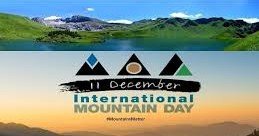
International Mountain Day reminds us of the critical importance of mountains, not only for those who live in their shadow but for the entire globe. In the context of Gilgit-Baltistan, the day highlights the urgent need to address the challenges posed by climate change, unplanned construction and mass tourism.
Read More
Murkum is, perhaps, the most prominent deity among the deities in Gilgit. She remains alive in the collective cultural memory and the remnants of ideas and rituals associated with her. Women believe that she is the one who favours the birth of a child.
Read More
Prof Kreutzmann’s explorations have taken him across the mountainous terrains of Xinjiang, Gilgit-Baltistan, Chitral, the Pamir Knot, Central Asia, and cities like London and Moscow. Over the years, he has authored numerous books, articles, and chapters that shine light on the complex history and geography of Central Asia, High Asia, and South Asia.
Read More
The leadership of the Awami Workers Party Gilgit-Baltistan Hunza expresses serious concern over the decision to hand over four power plants and future electricity projects and all water resources to a private company. We believe this move poses a risk of depriving the people of Hunza of their natural water resources, employment, and lands, which could enslave them to profit-driven corporate capitalism.
Read More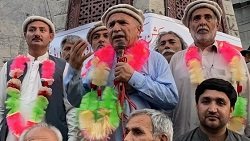
Political leaders, representatives from trade and hotel associations, and youth organizations addressed the protesters at Ittehad Chowk in Gilgit and Aliabad in Hunza and criticised Gilgit-Baltistan (G-B) authorities for what they termed as ‘anti-people decisions,’ including leasing public assets, tourist spots, and guest houses to the Green Tourism company.
Moreover, they denounced the leasing of mineral and water resources to corporate and influential entities, the increase in university fees, and the exploitation of local traders at the Sost border.
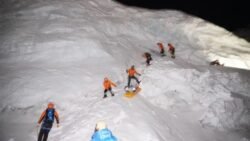
BBC KATHMANDU (Nepal): Tshiring Jangbu Sherpa cannot forget the dead body he saw just metres from the summit of Mount
Read More
Nowruz festival-related celebrations promote peace, prosperity, and solidarity within communities by recognizing the significance of our pluralistic identities.
Read More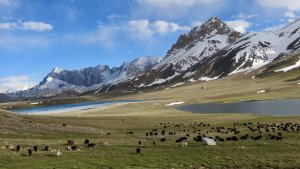
The wider Himalayan Arc, consisting of mountain ranges that incorporate major mountain systems such as the Tien Shan, Pamir, Hindu Kush, Karakoram, Himalaya, and Kun Lun Shan Mountains, is ecologically a very diverse mountainous region with peaks and plateaux. Steep mountain slopes and deeply incised valleys, glaciated areas above the snow lines, deserts and steppes, forests, rangelands, and wetlands compose a region that offers limited space for mountain communities to settle in compact oases and vast areas for extensive forms of pastoral practices herding predominantly for 16 million yaks, and much higher numbers of sheep and goats. About 60% of the Hindukush-Himalayan surface is composed of rangelands and pastures.
Read More
The Karakoram Highway (KKH), often referred to as the ‘Eighth Wonder of the World’, stands as a testament to human ingenuity and an engineering marvel connecting Pakistan and China. The 1,300-km highway meanders through some of the world’s most stunning landscapes and cultures and mountain ranges, including the Karakoram, Himalayas, and Hindu Kush. The KKH offers travelers a unique and awe-inspiring journey through lush valleys, waterfalls, and picturesque villages.
However, travelers must also be prepared for the challenges it presents, including safety concerns, remote conditions, and infrastructural limitations. A trail of tragic accidents and the loss of hundreds of precious lives annually on the highway reveals a darker reality that must be addressed urgently.
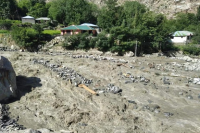
Climate change, neoliberal development, resource capture by the elite and the powerful as well as unbridled mass tourism have posed potential threats to the inhabitants, their society, culture, health, and the fragile ecology of Gilgit-Baltistan.
Read More